
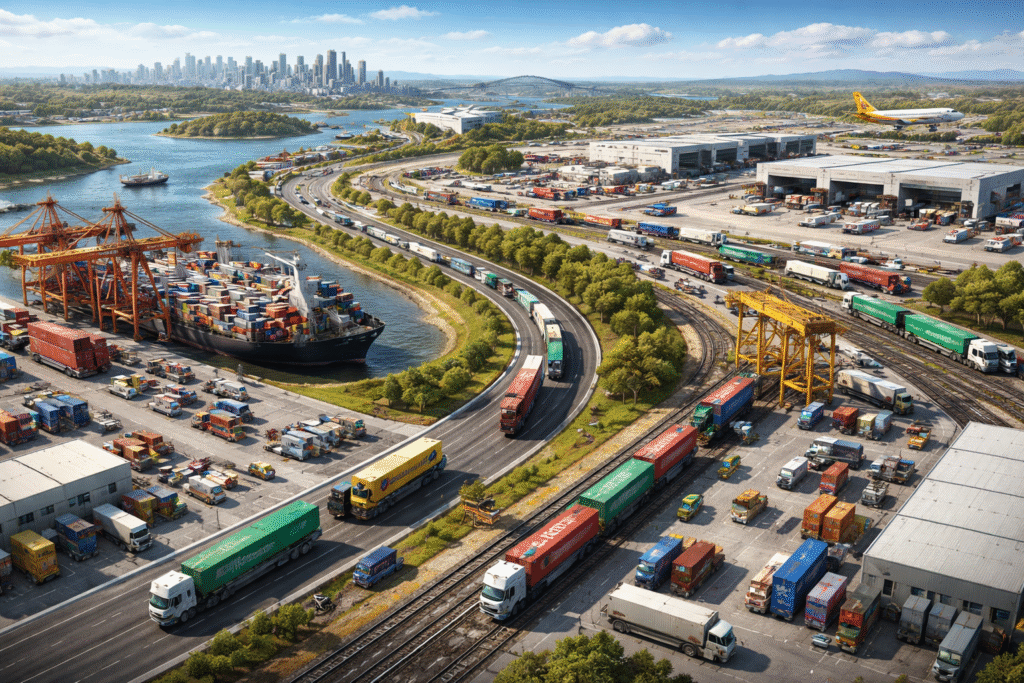
Australia moves enormous volumes of freight despite a geography that stretches supply chains to their limits. Mining exports depart from remote coastlines, agricultural products travel from inland regions to city markets, and imported consumer goods flow through a handful of major ports into national distribution networks. Logistics and transportation companies succeed here by combining strategic infrastructure access with systems that improve planning, visibility, and asset utilisation.
Infrastructure that enables national freight flows
Seaports are the main entry and exit points for containerised trade. Melbourne, Sydney (Port Botany), Brisbane, and Fremantle handle large container volumes, supported by logistics precincts with container storage, empty container parks, and transfer facilities. Bulk infrastructure—rail spurs, conveyor systems, and export terminals—underpins commodity supply chains in resource regions.
Road freight remains the most flexible mode, essential for last-mile distribution and for routes where rail coverage is limited. The national road network links capital cities and regional centres, enabling linehaul operations that feed metro distribution centres and smaller depots. Rail complements road by carrying heavier loads efficiently across long distances. Intermodal terminals allow containers to be shuttled by rail between major cities, then delivered by truck to final destinations. Air freight, while costlier, supports critical shipments requiring tight delivery windows.
Main players and service patterns
Australia’s logistics market includes large domestic operators, rail freight companies, parcel networks, and global forwarders:
- Large-scale logistics operators often provide contract warehousing, transport, and distribution under long-term agreements. Firms like Linfox and Toll are commonly associated with nationwide operations serving retail, FMCG, and industrial customers.
- Rail freight and intermodal specialists such as Aurizon and Pacific National support both bulk and container movements, working closely with port and terminal operators.
- Parcel and last-mile carriers led by Australia Post plus a range of private couriers that handle B2C deliveries, reverse logistics, and out-of-home pickup options.
- Global forwarding and express firms (including DHL and peers) focusing on international freight coordination, customs brokerage, and time-definite air services.
Efficiency solutions: making distance manageable
Because kilometres add up quickly, efficient planning can be as valuable as additional capacity. A TMS enables route optimisation, load building, appointment scheduling, and carrier selection. With accurate data, companies reduce empty running, improve on-time performance, and better match vehicle types to freight profiles.
Warehouses are another efficiency battleground. High-throughput sites use WMS-driven slotting, scanning, and performance dashboards to cut picking errors and speed up dispatch. Cross-docking reduces storage time for fast-moving SKUs, while multi-client facilities help spread fixed costs across customers. In sectors like grocery and healthcare, cold chain integrity is protected through temperature-controlled docks, validated packaging, and sensor-based monitoring.
Visibility technologies help prevent small issues from becoming major failures. GPS tracking and milestone scanning provide customers with ETAs and exceptions alerts. IoT devices can detect temperature excursions, door openings, or shock events—useful for sensitive freight. Some providers also use predictive analytics to anticipate delays based on weather, traffic patterns, or port congestion indicators.
Governance, safety, and resilience
Australia’s compliance requirements span fatigue management, heavy vehicle standards, mass limits, and chain-of-responsibility rules that influence how schedules and loading practices are designed. Biosecurity and quarantine processes matter for certain imports and for agricultural export preparation. Experienced providers embed documentation and audit trails into operations to protect shippers from costly disruptions.
With climate and infrastructure disruptions a reality, logistics firms increasingly build resilience into network design: alternative linehaul lanes, diversified carrier options, and temporary storage solutions. Companies that integrate infrastructure, technology, and compliance know-how deliver the most dependable efficiency—turning Australia’s long distances into a manageable operational equation.




More Stories
Australian Education Companies and Their Strategic Role in Building Global Human Capital Through Innovative Learning Systems
Australia’s Healthcare Companies in 2026: How Medical Innovation, Digital Health, and Patient Services Are Reshaping the Future of Care
How Australian Social Organizations Address Community Inequality, Climate Pressure, and Environmental Protection