
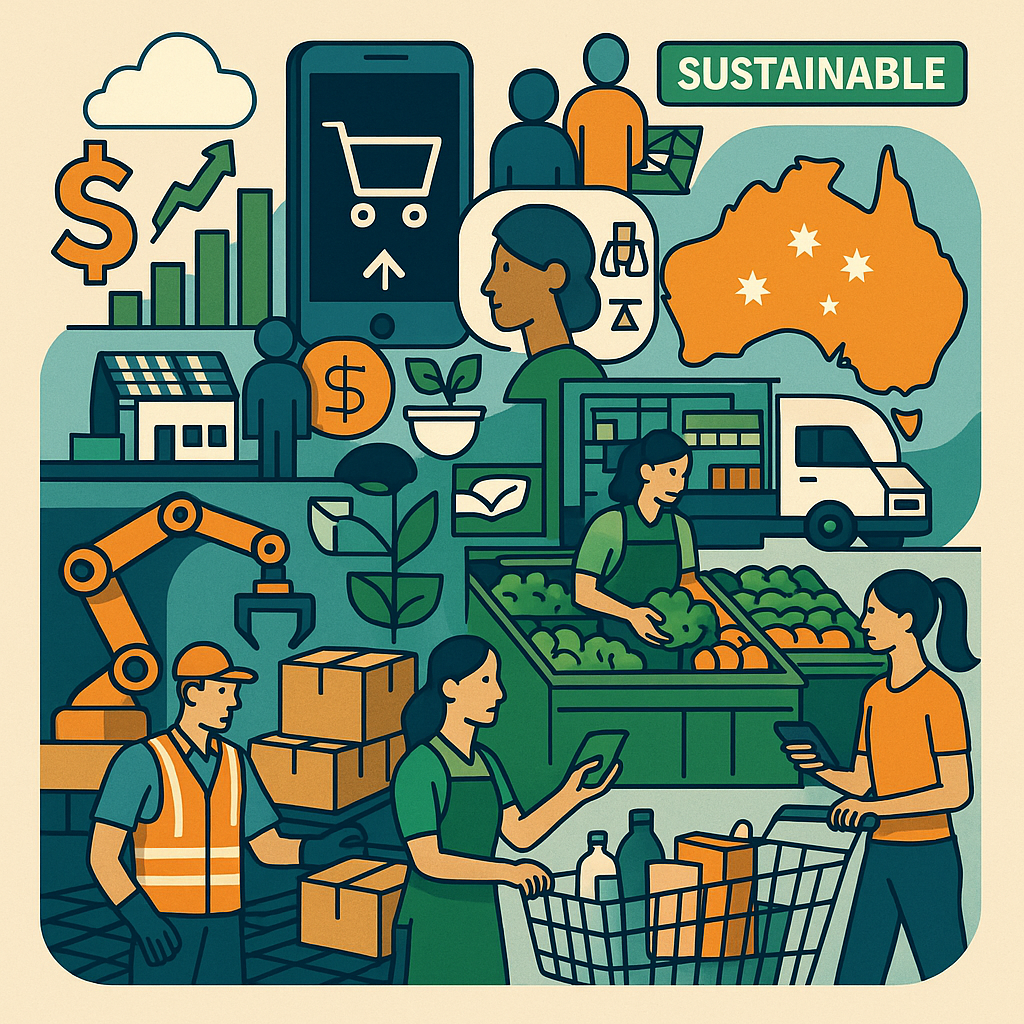
Discussions about retail in Australia frequently revolve around questions of concentration and competition. A few large supermarket and department store groups collectively hold a significant portion of the market, which has drawn periodic attention from regulators, politicians, and consumer advocates. This environment raises important questions about pricing, supplier treatment, and how much genuine choice consumers really have at the checkout.
Historically, dominance has stemmed from long-term investment in store networks, supply chain infrastructure, and brand building. Major companies secured prime locations in shopping centres, rolled out extensive suburban and regional coverage, and built loyalty through consistent product availability. Smaller independent retailers and convenience stores remained important, particularly in niche segments or local communities, but rarely matched the scale needed to challenge the big players nationally.
Over time, however, new forms of competition have emerged. Discount supermarkets and warehouse-style retailers have chipped away at market share by offering limited-assortment ranges and a strong focus on price. Their presence has forced incumbents to rethink their strategies, introducing more private-label products, sharper promotions, and value-oriented sub-brands. For consumers, this has meant more options within similar price tiers, and a more dynamic promotional environment.
Regulatory scrutiny has focused not only on consumer prices but also on the treatment of suppliers, including farmers, manufacturers, and small producers. Concerns about bargaining power and contract terms have led to industry codes of conduct and public discussions about fairness in the supply chain. Large retailers often respond by highlighting sustainability programs, local sourcing initiatives, and partnerships with small businesses to showcase a more collaborative approach.
From the consumer perspective, shopping behaviour reflects a blend of habit and strategic decision-making. Many households now “split their basket,” visiting multiple retailers in search of the best combination of price, quality, and convenience. A weekly grocery shop at one chain may be complemented by periodic visits to discount outlets, specialty stores, or online platforms for certain categories. This multi-channel, multi-retailer pattern means that dominance is measured not only in total sales, but also in share of mind and frequency of visits.
The digital revolution has introduced additional layers of competition. International e-commerce firms and local online specialists offer products that might be unavailable or more expensive in traditional outlets. Price comparison websites, social media reviews, and consumer forums give shoppers more information and bargaining power than in the past. Large Australian retailers have responded with price-match guarantees, everyday-low-price strategies on key items, and increased transparency around origin and ingredients.
Cost-of-living concerns have amplified consumer sensitivity to price movements. When households are under pressure, even small changes in grocery bills or household expenses can influence perceptions of fairness. Public debate about whether large retailers are passing on cost increases responsibly, or using inflation as a cover for higher margins, has become a recurrent theme in media discussions. This reputational risk further constrains how dominant players exercise their market power.
In this context, dominance in Australian retail is not a static condition. It is continuously tested by discount competitors, online entrants, regulatory attention, and more informed consumers. While large companies still hold significant structural advantages, the balance of power is gradually shifting towards shoppers who are better equipped to compare, criticise, and choose. Australian retail is moving toward a landscape where competition is less about sheer presence and more about perceived fairness, responsiveness, and value.




More Stories
The Effects of Global Expansion for Australian Companies
Australia’s Transport & Logistics Industry: Infrastructure, Providers, and Efficiency Levers
How Business Associations in Australia Amplify Industry Influence