
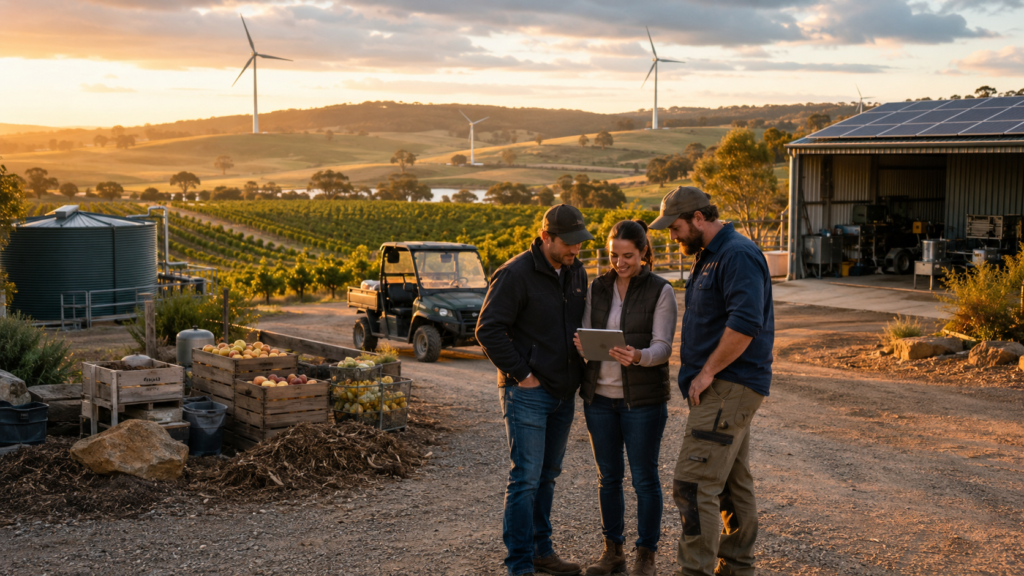
Sustainable Entrepreneurship Is Moving Beyond Green Branding
In 2026, Australia’s sustainable entrepreneurship movement is becoming less about marketing a business as “green” and more about redesigning how value is created from the beginning.
The strongest emerging businesses are no longer treating sustainability as a separate corporate responsibility program. Instead, they are integrating material efficiency, waste reduction, ethical sourcing and community impact directly into their revenue models.
This shift is particularly visible in sectors such as food, fashion, construction, packaging and technology. Entrepreneurs are examining what happens to products before they are made, while they are being used and after customers no longer need them.
The result is a new generation of Australian companies built around durability, repair, reuse, resale, recycling and product-as-a-service models.
Why the Circular Economy Is Becoming a Commercial Strategy
Waste Is Increasingly Viewed as a Business Design Failure
Traditional businesses generally follow a linear model: extract resources, manufacture a product, sell it and eventually discard it.
Circular entrepreneurs are challenging that system.
A furniture startup, for example, can design products with replaceable components rather than forcing customers to replace the entire item. A fashion company can introduce repair services or resale platforms. A food business can convert production by-products into ingredients, animal feed or new consumer products.
These approaches can reduce waste, but they may also create additional revenue streams.
That distinction is important. The most commercially promising sustainable businesses are not surviving only because customers feel ethically obligated to support them. They are finding ways to make lower resource consumption economically useful.
Australia’s Circular Economy Hub provides practical information and examples of circular business activity across the country. Its resources can be explored at https://acehub.org.au/.
A Real-World Australian Context: Rising Pressure on Resources
Australia’s geography creates a unique sustainability challenge. Long transport distances, exposure to climate-related disruption and dependence on complex supply chains can increase operating risks for entrepreneurs.
Circular models offer one way to reduce that vulnerability.
Businesses that recover materials locally, extend product life or create value from previously discarded resources may become less dependent on continuous access to virgin materials.
For founders, this means sustainability can function as a resilience strategy rather than simply an environmental commitment.
A company that understands where its materials come from, how much energy production requires and whether products can be repaired is generally better positioned to identify inefficiencies before they become expensive problems.
The 2026 Opportunity Is in Solving Specific Problems
Successful sustainable entrepreneurship will increasingly depend on precision.
Broad promises to “save the planet” are unlikely to be enough. Investors, commercial customers and consumers are asking more detailed questions.
How much waste is actually prevented? Can the product last longer? Does the business reduce operating costs for customers? Is the environmental benefit measurable? Can the model scale without increasing its negative impact?
Entrepreneurs capable of answering those questions have a stronger proposition.
The most interesting opportunities may emerge from highly specific problems: reusable packaging for one industry, repair technology for expensive equipment, platforms for redistributing surplus materials or software that helps businesses identify waste across supply chains.
In Australia’s 2026 entrepreneurial landscape, sustainable businesses are becoming more sophisticated because sustainability itself is becoming more practical.
The businesses most likely to stand out will not simply tell customers that responsibility matters. They will demonstrate that better use of resources can also create better products, stronger resilience and new forms of economic value.
More Stories
Merchant Backlash and Political Fallout: Inside the Resistance to Australia’s Card Surcharge Ban
The 2.8x Growth Advantage: Why AI-Adopting Australian SMEs Are Pulling Ahead
Leveraging Trade Agreements and Government Support Programs for Asia-Pacific Expansion