
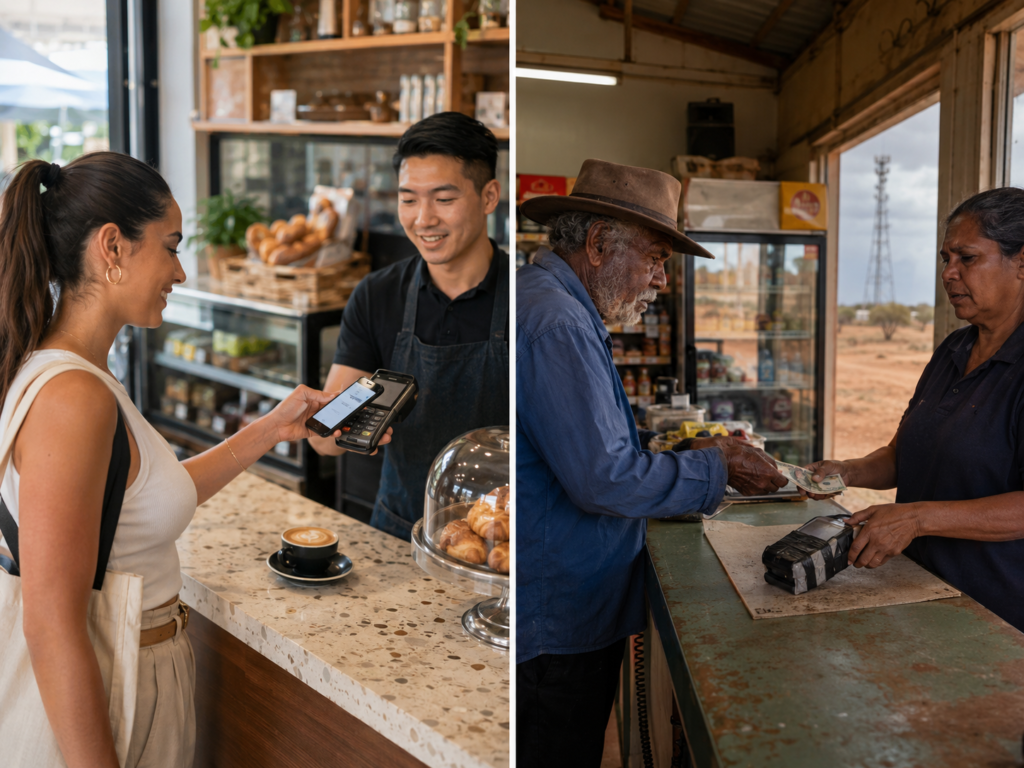
Digital Payments Move From Convenience to Daily Infrastructure
Australia’s growing reliance on digital payment applications in 2026 is not simply a story about consumers abandoning cash. It reflects a wider change in how people expect money to move: instantly, invisibly and with as little friction as possible.
Mobile wallets, banking applications and account-to-account payment services are increasingly integrated into ordinary routines. A customer can tap a phone at a supermarket, split a restaurant bill through a banking app and pay an online merchant without manually entering card details. Each transaction may appear simple, but together they are reshaping Australia’s payment economy.
The strongest foundation for this change was already visible before 2026. The Reserve Bank of Australia’s Consumer Payments Survey found that cash accounted for only 13 per cent of consumer payments in 2022, down sharply from 27 per cent in 2019. Cards represented the majority of transactions, while mobile devices were becoming increasingly important for in-person payments.
The official RBA analysis can be found here: Consumer Payment Behaviour in Australia.
That historical shift helps explain why digital payment apps have become such an important part of the Australian market.
Smartphones Are Becoming Financial Control Centres
The major change is not merely how Australians pay. It is how many financial tasks are now concentrated inside one device.
A typical banking or payment application may allow users to make payments, receive security alerts, freeze cards, manage subscriptions, monitor spending and verify large transactions. This combination creates a powerful behavioural advantage. Consumers no longer need to think of payment as a separate activity.
Younger Consumers Accelerate the Shift
Younger Australians are particularly comfortable treating a smartphone as both a wallet and a financial dashboard. However, the change is no longer limited to digitally native consumers.
Contactless payment habits established during the pandemic helped familiarise a broader section of the population with tap-and-go transactions. Improved biometric authentication, including fingerprint and facial recognition, also reduced some of the friction that previously made mobile payments feel complicated.
The result is a market in which convenience can quickly become expectation. A checkout process that requires too many steps may now feel outdated.
The Real-World Impact Is Visible Across Daily Life
Consider a commuter moving through a major Australian city. The same phone may be used to pay for transport, order coffee, settle a utility bill and transfer money to a family member. Digital payments are no longer confined to e-commerce. They follow the consumer across physical and online environments.
Small businesses are responding to the same shift. Cafés, market stalls and service providers can increasingly accept digital payments through compact terminals or smartphone-based systems. This lowers some traditional barriers to electronic payment acceptance.
At the same time, digital payments generate richer transaction records. Consumers gain clearer spending histories, while businesses can connect payment information with inventory, accounting and loyalty systems.
Trust Will Determine the Next Stage of Growth
Convenience alone will not guarantee continued adoption. Australians are also increasingly alert to scams, data theft and unauthorised transactions.
The most successful payment applications in 2026 are therefore likely to be those that combine speed with visible security. Real-time alerts, biometric verification, payment controls and clear dispute processes are becoming competitive features rather than optional extras.
Australia’s digital payment boom is ultimately about more than replacing banknotes with smartphones. It marks a transition toward a financial environment where consumers expect money to move as quickly and intuitively as information.




More Stories
Australia’s Insurance Industry Transformation: How Regulation, Digital Innovation, and Consumer Demand Are Reshaping the Market in 2026
Australia’s Central Bank in 2026: How the RBA Shapes Inflation, Jobs and Household Spending
The Battle Between Established Banks and Digital Banks in Australia