
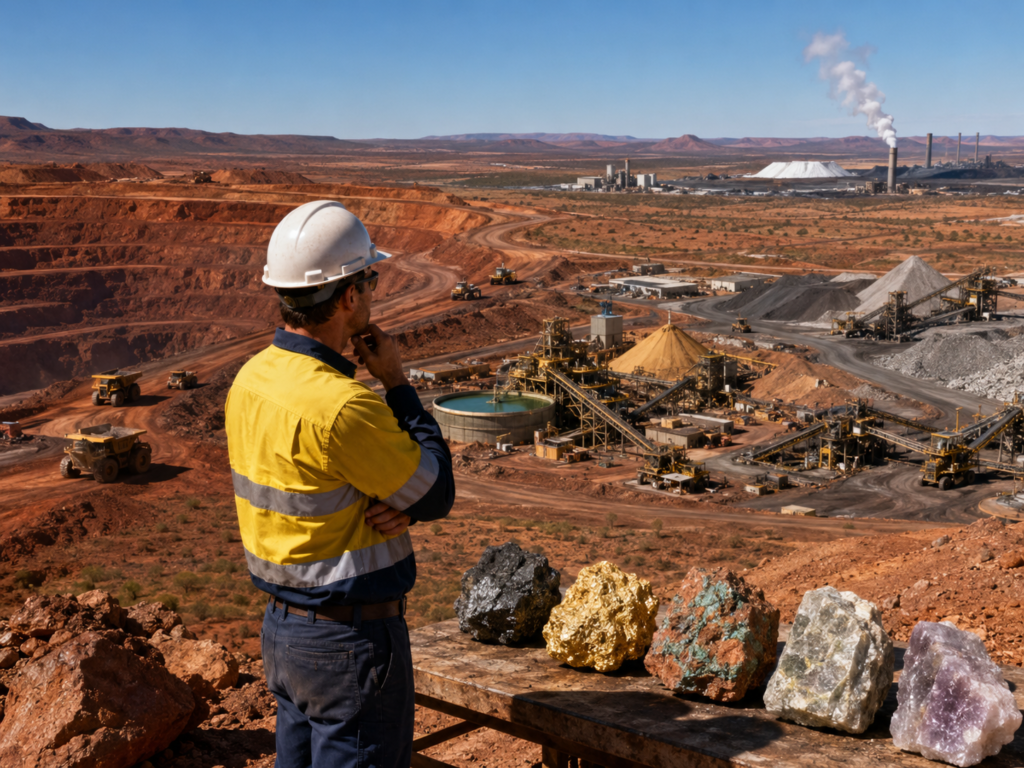
Australia’s equity market is closely connected to the global commodity cycle. Major mining companies such as BHP, Rio Tinto, Fortescue, Newmont Australia and South32 account for a meaningful share of the Australian Securities Exchange’s market value, dividend income and institutional portfolio exposure.
For investors, this concentration creates both opportunity and vulnerability. Strong commodity prices can generate substantial free cash flow, special dividends and share buybacks. However, falling demand from China, rising operating costs or unexpected regulatory changes can quickly reduce earnings expectations.
The Australian Government’s Resources and Energy Quarterly provides official forecasts for commodity export earnings, production and global demand. Investors can use this publication to compare company guidance with broader industry conditions.
Iron Ore Still Drives Large-Cap Mining Earnings
Iron ore remains one of the most important earnings sources for Australia’s largest miners. BHP, Rio Tinto and Fortescue benefit from large-scale Pilbara operations, established infrastructure and relatively competitive production costs.
The main risk is Australia’s dependence on Chinese steel demand. A slowdown in China’s property sector can reduce construction activity and pressure iron ore prices. At the same time, infrastructure stimulus, manufacturing investment or stronger steel exports may support demand.
Investors should therefore look beyond the headline iron ore price. Production costs, shipment volumes, ore quality and capital expenditure can determine whether a company remains profitable during a weaker cycle.
Why Cost Position Matters
A low-cost producer can continue generating cash even when commodity prices decline. Higher-cost operators may need to reduce production, delay expansion or raise additional capital.
This difference explains why large diversified miners are often viewed as more defensive than smaller single-asset companies.
Gold Offers a Different Risk Profile
Australian gold stocks can perform differently from iron ore and coal companies. Gold demand is influenced by interest rates, central-bank buying, currency movements, geopolitical tension and investor demand for defensive assets.
When the Australian dollar weakens against the US dollar, local gold producers may receive higher Australian-dollar revenue because gold is internationally priced in US dollars. However, labour shortages, diesel expenses, equipment costs and declining ore grades can offset that benefit.
Investors should examine all-in sustaining costs rather than focusing only on production growth.
Lithium Highlights the Risks of Commodity Euphoria
Australia became a major supplier of lithium raw materials during the electric-vehicle investment boom. Yet the sharp correction in lithium prices demonstrated how quickly market expectations can change when new supply grows faster than demand.
Producers with strong balance sheets, high-quality deposits and integrated processing strategies may be better positioned than highly leveraged developers. Rio Tinto’s move toward greater lithium exposure also illustrates how established mining groups view battery materials as a long-term strategic market, despite short-term volatility.
What Investors Should Monitor
Commodity investing requires analysis of both the company and the underlying market. Investors should monitor realised prices, production costs, debt, project execution, dividend coverage and exposure to individual customers.
Australian mining stocks can provide attractive income and global growth exposure, but they should not automatically be treated as stable dividend investments. Their earnings remain cyclical, and portfolio sizing should reflect that reality.


More Stories
Office Property in Australia 2026: Navigating the Bifurcation Between Prime and Secondary Assets
The Index Effect: How Vanguard and BlackRock’s Passive Billions Are Reshaping ASX 20 Valuations and Risk in 2026
Australian Corporate Bonds vs Semi-Government Bonds in 2026: Credit Spreads, Liquidity, and Income Allocation