
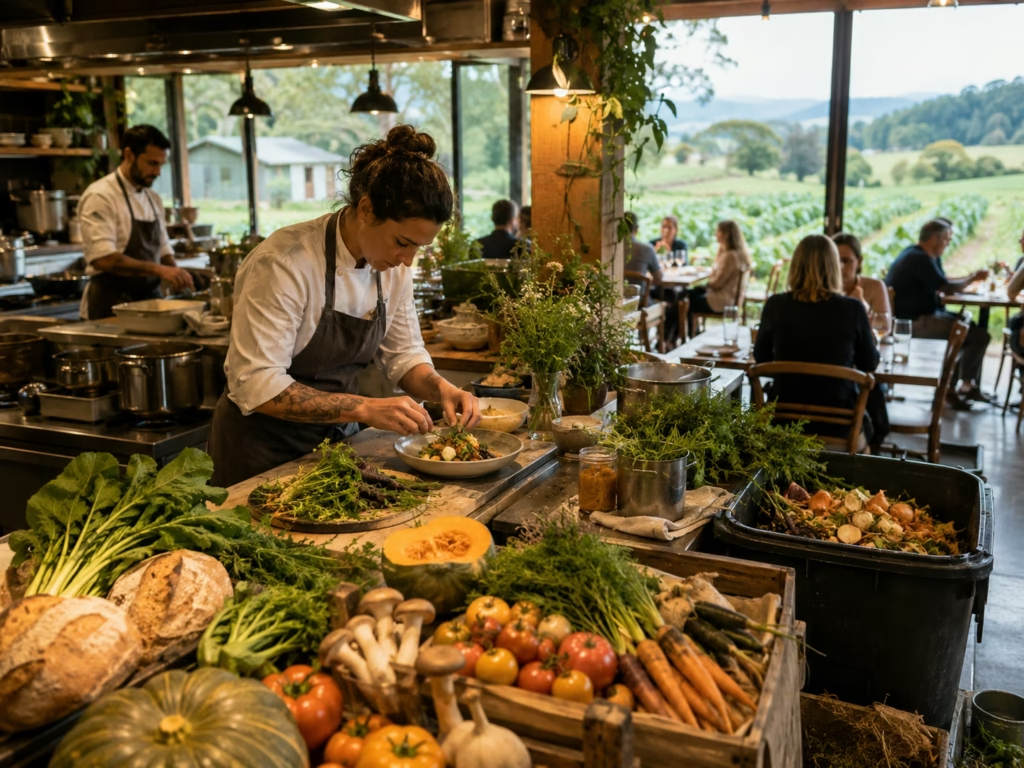
Australia is finally embracing its own pantry. After decades of overlooking the ingredients that Indigenous Australians have cultivated for over 60,000 years, the country’s restaurant industry is experiencing a bush tucker boom. In 2026, native ingredients are not just appearing on degustation menus—they are stocked in mainstream supermarkets and featured in fast-casual chains. This shift is both a culinary and cultural reckoning.
The Market Data
The Australian Bureau of Statistics’ Food Services Industry report (March 2026) shows that consumer spending on native ingredient–based dishes grew by 28% in the past twelve months. Restaurants featuring at least five native ingredients on their menu reported an average 15% higher average spend per customer. This data, available at https://www.abs.gov.au/, underscores a fundamental change in diner expectations. People no longer see wattleseed or lemon myrtle as exotic; they see them as local and modern.
Chefs Leading the Charge
Mark Olive, the Bundjalung chef who has championed native cuisine since the 1980s, now consults for major hospitality groups. His Sydney restaurant, Midden, has a year-long waiting list. Olive’s approach is radical in its simplicity: he treats native ingredients as the backbone of Australian cooking, not as a garnish. “We don’t sprinkle finger lime on a European dish and call it fusion,” Olive explains. “We build the dish from the ground up using what this land gives us.” His signature wattleseed damper with saltbush butter is now copied by dozens of cafés nationwide.
From Fine Dining to Fast Casual
What was once confined to high-end venues has spread to the mainstream. Grill’d now offers a “Native Roo Burger” featuring kangaroo patty, bush tomato chutney, and macadamia aioli across all 160 locations. It became the chain’s third-best-selling item within six months of launch in late 2025. Similarly, Boost Juice introduced a Davidson plum smoothie that outperformed its mango classic in initial trials. This mainstream acceptance is driven by younger diners, 64% of whom say they actively seek out native Australian flavours.
Cultural Sensitivity and Sustainability
The bush tucker boom is not without complications. There is growing demand for ethical sourcing and Indigenous ownership of supply chains. Organisations like the Indigenous Land and Sea Corporation are working with restaurants to ensure that native ingredient harvesting benefits Aboriginal communities directly. “It’s not enough to put kangaroo on the menu,” says native food advocate Aunty Dale Chapman. “You have to know whose land it came from and pay them fairly.” The industry’s next challenge is to build a transparent, community-led native food economy.

More Stories
Merchant Backlash and Political Fallout: Inside the Resistance to Australia’s Card Surcharge Ban
The 2.8x Growth Advantage: Why AI-Adopting Australian SMEs Are Pulling Ahead
Leveraging Trade Agreements and Government Support Programs for Asia-Pacific Expansion