
A Commercial Pedigree Built Underground
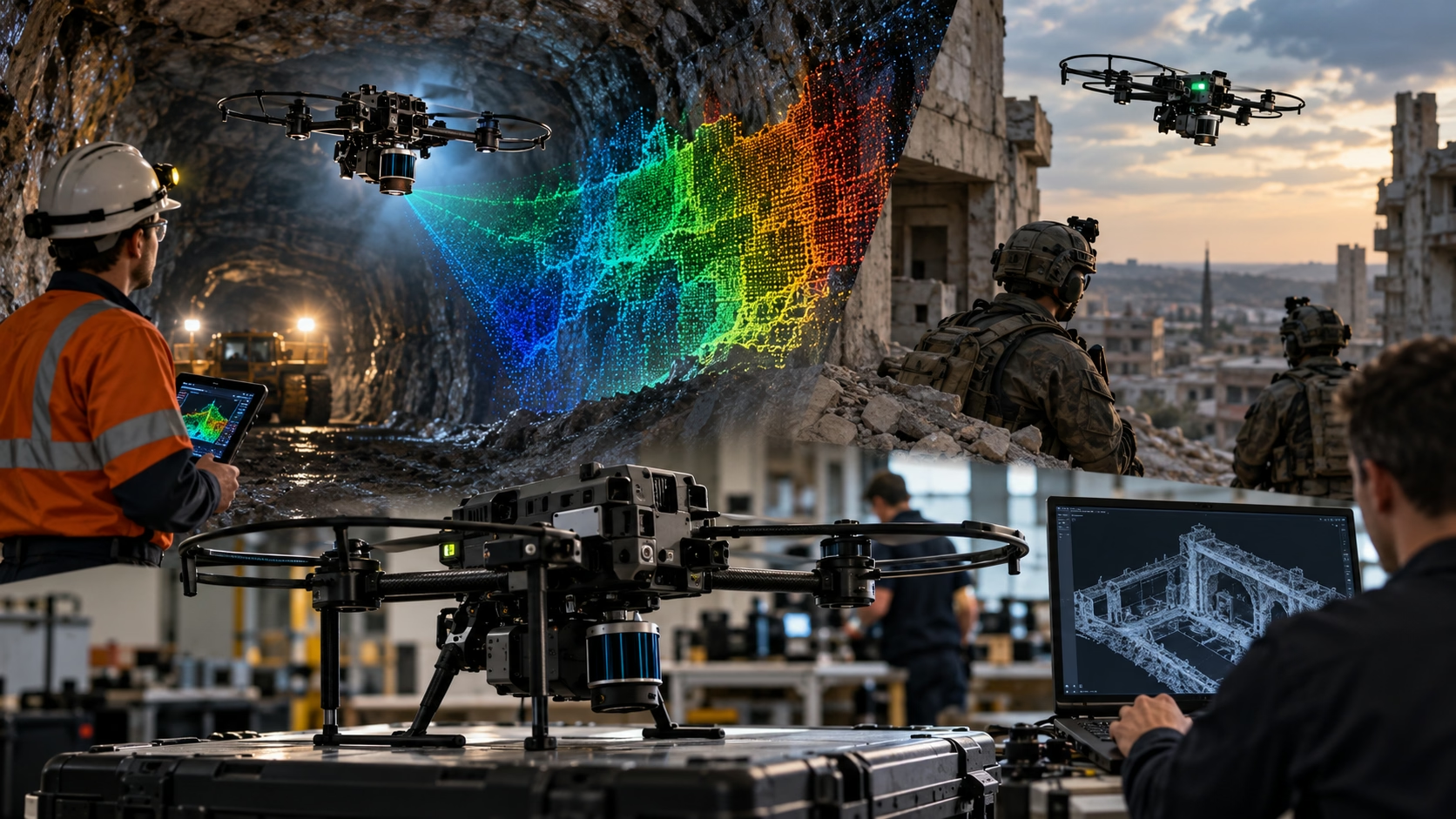
Before Emesent became a defence tech story, it was a mining and construction story. Spun out of CSIRO, the Brisbane-based company built sensors that attach to drones and, using onboard AI and 3D mapping software, survey areas without the need for GPS. That capability won it Tier One mining customers including BHP and Rio Tinto, and it gave the company something rare in defence tech: a product that had already survived years of hostile, dust-choked, GPS-denied industrial environments.
In 2026, Emesent raised $25 million in fresh funding that included $10 million in venture debt from the National Reconstruction Fund Corporation, alongside equity from NGS Super, Hostplus, Main Sequence and Queensland’s QIC Ventures. The deal is notable not only for its size but for its structure: it marked the NRF’s first foray into venture debt, a financing instrument that lets startups scale manufacturing without founders diluting existing shareholdings.
The Pivot to Defence Reconnaissance
Emesent CFO David Nucifora has been explicit about the strategic shift. “Construction and mining have become our two primary use cases, but the other big development that’s happened [since our 2022 Series A] is our ability to enter into defence, specifically with reconnaissance,” he told Forbes Australia. “We’ve got to increase capacity at our plants to meet demand, as well as the growth in defence”. The company’s Wacol plant in Queensland is being expanded to meet that demand, and the $25 million raise is expected to add 20 roles to an existing team of 109.
The defence relevance is straightforward. Modern reconnaissance increasingly depends on uncrewed systems that can operate in environments where satellite navigation is jammed or unavailable. Emesent’s AI-driven 3D mapping and GPS-free navigation allow a drone to build a representation of its surroundings and navigate relative to that representation—exactly the kind of capability that militaries are seeking as electronic warfare becomes more pervasive. The same technology that lets a mining drone map a stope without GPS can let a reconnaissance drone map a contested urban block or a tunnel network without emitting a signal.
Why Venture Debt and Sovereign Capital Matter
The NRF’s venture debt participation is a signal about how Australia is trying to finance defence scale-up. Venture debt is far less common in Australia than in the United States, where an estimated US$68 billion was issued last year. By using debt rather than pure equity, Emesent can invest in manufacturing capacity and working capital without further diluting founders—a structure that matters for a company trying to move from bespoke sensor production to defence-grade volume. NRF chief investment officer Mary Manning framed the role explicitly: “Part of the NRF’s role is to fill gaps in the market”.
Emesent’s trajectory also illustrates a broader pattern in Australian defence tech: commercial dual-use companies are not pivoting away from their civilian customers, but layering defence demand on top of proven industrial use cases. That layering is strategically valuable. It gives startups revenue resilience, shortens the path to defence certification because the core technology is already field-hardened, and allows sovereign capital to support companies that have already demonstrated product-market fit rather than betting on prototypes. For a sector trying to build exportable, sovereign capability, Emesent offers a template: win in the hardest commercial environments first, then bring that maturity to the battlefield.

More Stories
Government Policy and the Architecture of Australia’s Deep Tech Future
VR Startups Transform Australian Aged Care and Healthcare Training with Immersive Technology
Revolut’s Australian Banking Licence and the Financial Super App Revolution