
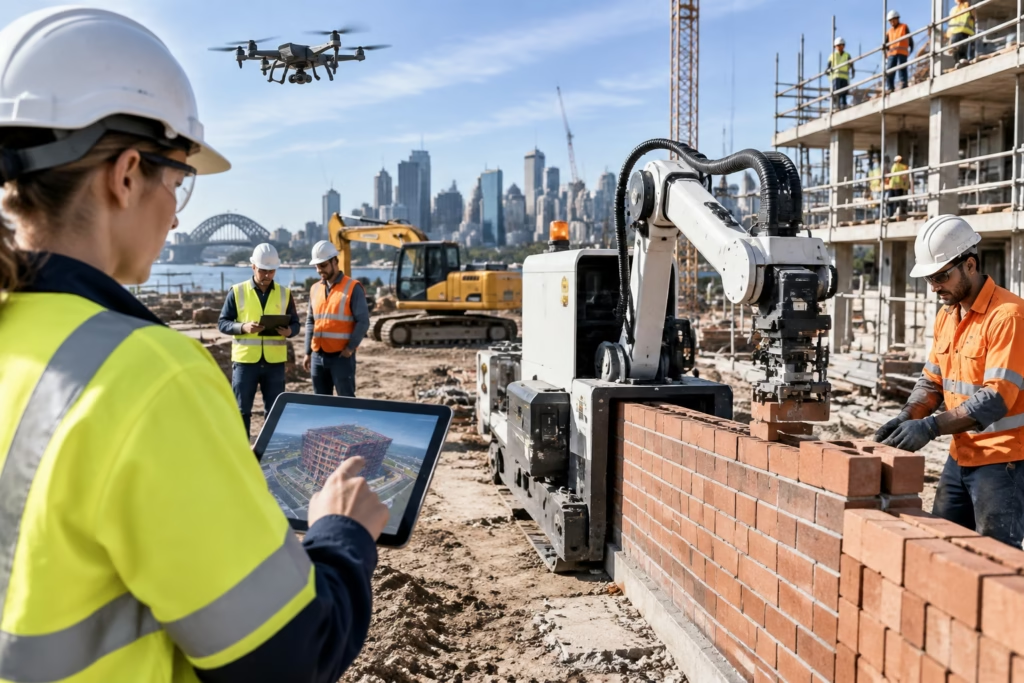
The Australian building industry has historically been one of the nation’s largest producers of waste. Demolition sites and skip bins have long been symbols of the sector’s linear “take-make-dispose” model. However, a dramatic shift is underway. Driven by rising landfill levies, supply chain disruptions, and strict government procurement policies, construction companies are embracing the circular economy. In 2026, waste is being viewed not as a liability, but as a valuable commodity.
Designing for Deconstruction
The movement begins long before the excavators arrive. Architects and engineers are now practicing “Design for Disassembly” (DfD). This approach mandates that buildings are designed in a way that allows their components—be it steel beams, timber panels, or glass facades—to be easily removed and reused at the end of the building’s life. This is a radical departure from traditional methods that rely on adhesives and composite materials that are impossible to separate.
Major commercial developers are recognizing the long-term value of this approach. A building that is designed for deconstruction retains asset value even when it becomes obsolete. Construction companies that can demonstrate DfD expertise are winning high-profile tenders, as clients seek to future-proof their portfolios against volatile raw material prices and stricter environmental regulations.
The Crushing Reality: Recycling Aggregates
On the ground level, the most significant circular economy practice is the recycling of concrete and masonry. Mobile crushing units are now a common sight on demolition sites. Instead of trucking debris to landfills, contractors crush it on-site to create Recycled Crushed Aggregate (RCA). This material is then used for road bases, drainage layers, and even in new concrete mixes for non-structural elements.
The benefit is twofold: it eliminates the massive cost of landfill disposal and reduces the need to quarry virgin rock. According to the Green Building Council of Australia (GBCA), projects that maximize the use of recycled materials are achieving higher Green Star ratings, which are increasingly mandatory for government-funded projects. The GBCA’s 2026 guidelines emphasize a 60% reduction target for construction waste to landfill (GBCA – Building with Nature 2026).
Timber: The Carbon Sink Revival
Another notable trend is the resurgence of engineered timber. Cross-Laminated Timber (CLT) and Glulam are being used for high-rise structures, replacing steel and concrete. Unlike concrete, which emits carbon during production, timber sequesters carbon. Australian firms are now sourcing timber from certified sustainable forests and utilizing off-site prefabrication to reduce on-site cutting waste. Offcuts from the factory are pelletized for biomass energy, creating a closed-loop system that significantly lowers the carbon footprint of a building.
This shift is forcing traditional subcontractors to adapt. Carpenters are becoming assembly technicians, and the tolerance for on-site waste is shrinking rapidly. The construction site of 2026 is quieter, cleaner, and significantly more efficient than its predecessors, proving that profitability and sustainability are no longer mutually exclusive in the Australian market.


More Stories
The Interchange Squeeze: How Australia’s Banks Are Rewriting the Credit Card Playbook
PayTo Is Quietly Becoming the Backbone of Australian A2A Payments — Here’s How
Compliance, Complexity, and Competition: The Operational Realities of CDR Expansion for Non-Bank Lenders