
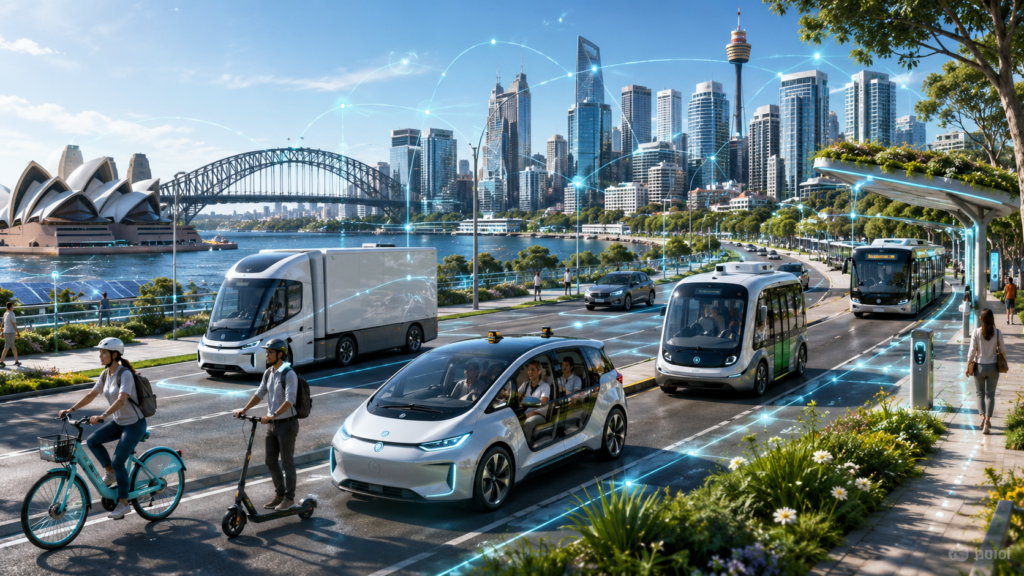
Australia’s transport sector is undergoing a technological revolution, driven by start-ups that innovate across mobility, logistics, and sustainable transport solutions. These emerging companies are redefining how people move within cities and how goods are transported, leveraging digital platforms, AI, and electric and autonomous vehicles.
A major focus is Mobility-as-a-Service (MaaS), which integrates various modes of transport into a single, user-friendly platform. Companies such as GoGet provide seamless access to ride-sharing, e-scooters, public transport, and bicycles. By simplifying the planning, booking, and payment processes, MaaS platforms reduce congestion, promote environmentally friendly transport, and enhance convenience for commuters. Real-time route optimization further improves efficiency, helping users avoid delays and make informed travel choices.
Electric vehicles are a key innovation introduced by start-ups like SEA Electric, which produce battery-powered commercial trucks and vans. These vehicles not only reduce carbon emissions but also lower fuel and maintenance costs. Government incentives and subsidies encourage businesses to adopt electric fleets, accelerating the transition to sustainable transport solutions. The continuous improvement in battery technology is crucial in making electric mobility more practical and widespread.
Artificial intelligence is reshaping logistics and fleet management. Start-ups such as RazorLabs employ AI-driven algorithms to predict traffic congestion, optimize delivery routes, and maximize fleet efficiency. These systems also provide valuable data for urban planners, improving infrastructure development and traffic management. By analyzing patterns and trends, AI solutions enable smarter, more efficient cities.
Autonomous vehicles (AVs) are gradually being introduced through pilot programs. Australian companies like Aurrigo Australia are testing self-driving shuttles in urban environments, exploring the potential for reducing congestion and enhancing accessibility. Regulatory approval and safety validation are ongoing, but these initiatives demonstrate the pivotal role of start-ups in preparing for a future of driverless transport. Collaboration with government bodies and research institutions ensures AV technology is integrated safely and effectively.
Start-ups are also tackling challenges in urban logistics and last-mile delivery. Innovations include robotic couriers, AI-based route optimization, and electric delivery vans. These technologies help meet rising e-commerce demand while minimizing traffic congestion and environmental impact. Efficient last-mile solutions are essential to modern urban transport networks, ensuring faster and more sustainable delivery services.
Investment and funding are vital for these start-ups. Venture capital backing and government grants, such as those from the Australian Renewable Energy Agency (ARENA), provide resources for research, development, and scaling operations. These financial supports enable start-ups to experiment with novel technologies and implement solutions that could redefine transport across Australia and beyond.
Through MaaS, electric fleets, AI-driven optimization, autonomous vehicles, and innovative logistics, Australian start-ups are modernizing the transport sector. Their innovations enhance convenience, reduce environmental impact, and support sustainable urban growth, paving the way for a technologically advanced and integrated transport future.




More Stories
Australia’s Game Development Boom: How Tax Incentives and Independent Studios Are Building Global Businesses
Australia’s Technology Start-up Investment Outlook for 2026: Where Capital Is Moving and Which Sectors Offer the Strongest Potential
How Australian SMEs Can Turn AI, Automation, and Digital Services into Growth Engines in 2026