
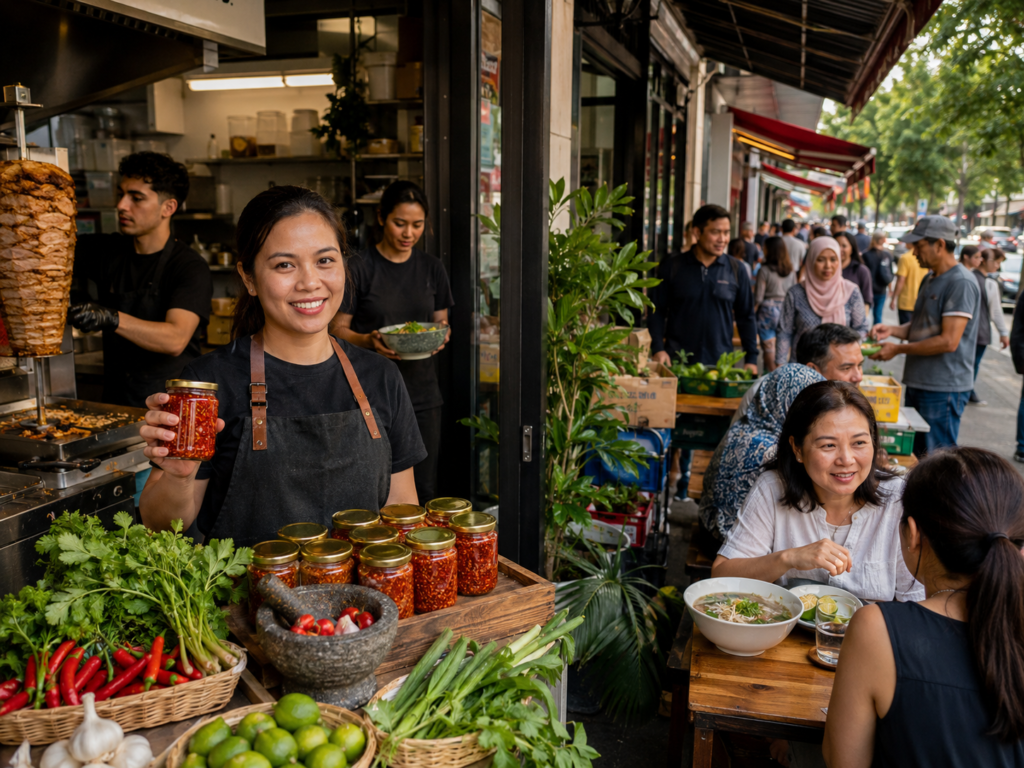
The aroma of freshly blended sambal, the sizzle of authentic shawarma, the artful presentation of vegan pho—these sensory markers now define countless Australian shopping strips. Behind them is a powerful economic force: first-generation migrant food entrepreneurs. Far beyond cultural enrichment, they are revitalising high streets, generating employment, and anchoring supply chains that ripple across local economies.
The Rise of the Migrant Food SME
In suburbs from Footscray to Cabramatta, culinary businesses founded by migrants have become critical economic nodes. They occupy long-vacant shopfronts, increase foot traffic, and stimulate ancillary services such as local cleaning, security, and produce suppliers. According to the Australian Bureau of Statistics’ 2026 publication Migrant Entrepreneurs and Business Ownership, Australia, 2025-26 (ABS, 2026), food and accommodation services represent the largest single sector for migrant-founded enterprises, accounting for 24% of all new migrant-led businesses in 2025.
Real-World Impact: Maria’s Sambal Empire
Take Maria, an Indonesian-born entrepreneur who arrived in Melbourne in 2019. She began bottling her grandmother’s sambal in a home kitchen, selling it at weekend markets. By early 2026, her brand—Nusa Heat—operates a commercial kitchen in Dandenong, employs 15 local staff, and exports to Singapore and New Zealand. “We source 90% of our chillies from Victorian growers and all our packaging from a local manufacturer,” Maria explains. Her story mirrors a broader pattern: migrant food founders multiply local economic value by integrating deeply with domestic supply networks.
Beyond Hospitality: Supply Chain Integration
ABS data confirms this multiplier effect. Migrant-owned food businesses in 2026 were 30% more likely to use local suppliers for core ingredients than non-migrant counterparts, according to the same report. This localised procurement helps insulate regional farming and manufacturing from global supply shocks. Moreover, these businesses generate significant casual employment—often the first job entry point for young Australians and newly arrived migrants themselves.
Cultural Ambassadors Driving Tourism
Culinary migration also fuels experience-based tourism. Food tours in migrant-rich precincts have surged, with Visit Victoria reporting a 22% year-on-year rise in culinary trail participants. When a single Ethiopian café in Footscray attracts interstate visitors, it spills dollars into nearby accommodation, transport, and retail. Each plate served becomes a quiet economic development strategy, strengthening Australia’s domestic tourism fabric without heavy infrastructure spend.
The baked-in resilience of these enterprises is striking: during 2025 cost-of-living pressures, migrant food SMEs pivoted rapidly to frozen meal delivery and condiment lines, sustaining cash flow and jobs. Their agility, born from cross-cultural experience and necessity, is now a structural advantage in Australia’s competitive SME landscape. As the 2026 ABS data shows, their contribution is not a temporary phenomenon—it is a permanent, growing pillar of local economic growth.

More Stories
Merchant Backlash and Political Fallout: Inside the Resistance to Australia’s Card Surcharge Ban
The 2.8x Growth Advantage: Why AI-Adopting Australian SMEs Are Pulling Ahead
Leveraging Trade Agreements and Government Support Programs for Asia-Pacific Expansion