
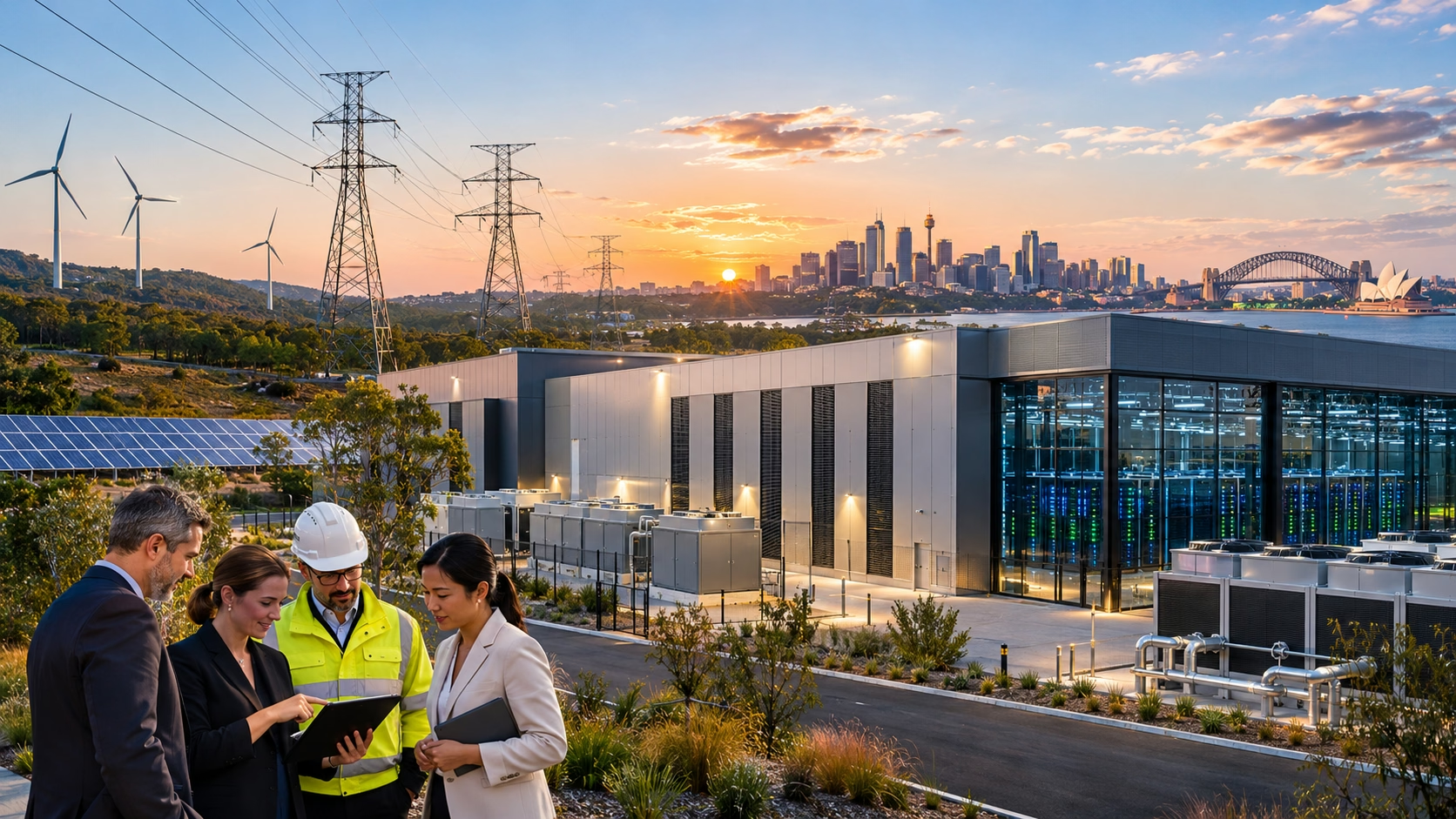
A Structural Reordering of Australia’s Digital Infrastructure Geography
For more than a decade, Sydney was the uncontested centre of gravity for Australian data centres. That assumption no longer holds. Data Centres Australia’s second Australian Data Centre Forecast Report, produced with DC Byte, shows Melbourne’s total forecast pipeline reaching 10.7 GW, surpassing Sydney’s 7.8 GW—a reversal that reflects not a sudden surge in Melbourne announcements, but a faster conversion of existing projects from early-stage planning into committed development.
The Approval Process Is the Differentiator
The numbers tell a story of administrative velocity. Melbourne recorded a 1.2 GW increase in committed capacity during the reporting period, compared with 0.7 GW in Sydney. The report links that gap to planning and approvals: Victoria’s Development Facilitation Program has moved projects through the development process more quickly than New South Wales’ State Significant Development process. Sydney’s total pipeline fell by 3.6 GW, while its early-stage capacity dropped by 4.4 GW, a decline the report attributes to a combination of energy constraints, less certain policy approval timelines, and recent policy announcements in New South Wales.
Energy Availability Is Redrawing the Map
The Melbourne–Sydney shift is not merely a planning story. Energy availability is increasingly shaping where large-scale digital infrastructure can be built. Western Sydney’s transmission capacity has already been heavily allocated, with Transgrid reporting about 1.5 GW covered by signed agreements and further large connections requiring network augmentation. Victoria, by contrast, has attracted attention for what the report describes as an “open for business” message from the state government, even as recent policy changes may affect future forecasts.
The geographic broadening extends beyond the two largest cities. The share of forecast pipeline capacity outside Sydney and Melbourne has risen from 19% in Q3 2024 to 31% in September 2026, with early-stage projects emerging in Queensland, Tasmania, South Australia, and Western Australia. Developers are looking to regional locations where power is more readily available, land is cheaper, and community opposition may be less intense—though water availability and local planning frameworks are emerging as new tests.
What the Shift Means for Infrastructure and Energy Providers
For infrastructure companies, the reordering of the data centre map creates both opportunity and complexity. Transmission and distribution networks in Victoria and Queensland will face accelerated connection requests, while New South Wales may see a period of consolidation as developers reassess projects against tighter energy and policy conditions. For energy providers, the shift reinforces the case for geographically diversified generation and storage investment—particularly in regions where data centre load can be matched with new renewable capacity.
Data Centres Australia CEO Belinda Dennett has argued that Australia’s renewable energy potential and reliable energy market are among the country’s strongest attributes for sustainable data centre development, adding that if AI models are trained and fine-tuned using Australian renewable energy, the emissions from that compute can be up to four times lower than in regional markets running on fossil fuels. The geographic shift now underway is, in effect, a test of whether that advantage can be converted into delivered capacity at the pace the market demands.

More Stories
The Mid-Market Countdown — Group 2 and Group 3 Entities Face Their AASB S2 Moment
APRA and ASIC Tighten the Screws on Private Credit as Australia’s Non-Bank Lending Sector Hits $200 Billion
Mining and Resources M&A: Australia’s Critical Minerals Attract Record Deal Flow