
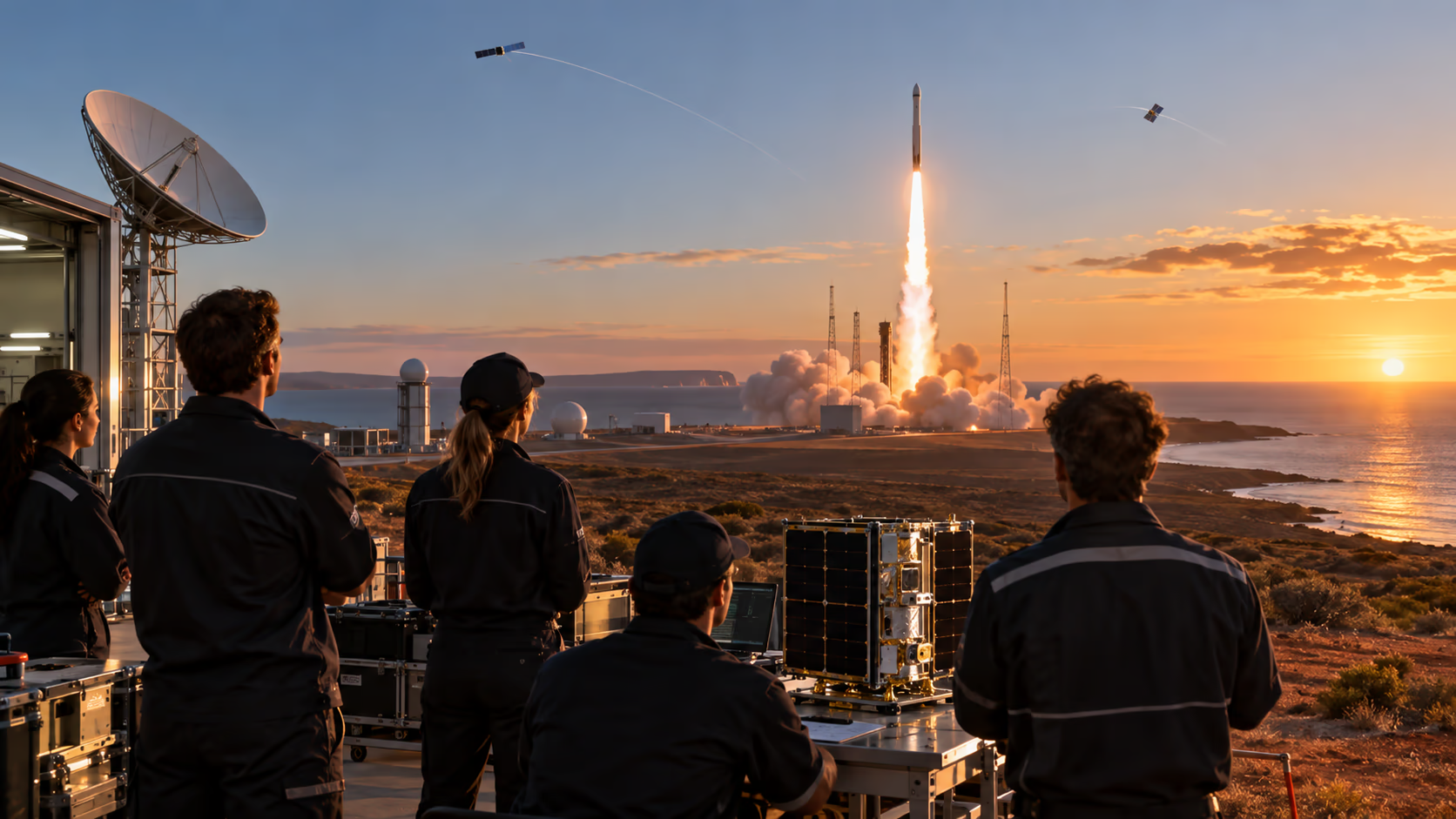
Australia’s satellite sector is no longer a supporting actor in the global space economy. In 2026, local startups are designing, building, and operating small satellites that deliver data, connectivity, and imagery to customers on Earth. The shift is powered by advances in miniaturisation, falling launch costs, and a growing demand for sovereign space-based services.
At the centre of this wave is Gilmour Space Technologies. While the company is best known for its Eris rocket, its ElaraSat satellite bus is equally important. The 100-kilogram platform has already demonstrated successful on-orbit operations. It is designed to host a range of payloads, from communications and Earth observation to scientific instruments. By offering a standardised bus, Gilmour lowers the barrier for smaller startups and research institutions that want to fly payloads but lack the resources to build a complete satellite. The company’s $217 million Series E round, which included $75 million from the National Reconstruction Fund Corporation and $75 million from Hostplus, is accelerating production of both Eris and ElaraSat.
Myriota has taken a different route. The Adelaide-based company operates a direct-to-satellite IoT network that connects remote sensors without relying on mobile towers. Its technology is used in agriculture, mining, environmental monitoring, and logistics. In a country as vast as Australia, where terrestrial coverage is limited, satellite IoT is not a luxury. It is infrastructure. Myriota’s network allows farmers to monitor soil moisture, mining companies to track equipment, and environmental agencies to detect bushfires and floods in real time. The company is part of a broader trend: Australian startups are using satellites to solve uniquely Australian problems, then exporting those solutions globally.
Earth observation is another growth area. Several Australian firms are developing small satellites equipped with advanced sensors for agriculture, forestry, disaster response, and defence. These satellites can detect crop health, map bushfire fuel loads, monitor coastal erosion, and track illegal fishing. The data they produce is increasingly valuable to government and industry. The Australian Space Agency’s official portal (https://www.australianspaceagency.gov.au/) identifies satellites and multi-orbit constellations as core platforms for the nation’s space future. Its 2026 data shows strong growth in commercial satellite applications, particularly in remote sensing and communications.
The Venture Catalyst Space program at Adelaide University’s Innovation & Collaboration Centre is nurturing the next generation of satellite innovators. Its 2026 cohort includes eight startups working on microgravity research, climate risk, advanced materials, and space-enabled data solutions. Since 2018, the program has supported 54 startups, helping them attract up to $135 million in investment. One participant, THE RED PLAN-ET, is developing sustainable menstrual care for long-duration space missions, a niche but telling example of how space innovation can address human needs beyond hardware.
The government’s Statement on Space, released in July 2026, reinforces the strategic importance of satellites. It outlines a vision for an enduring space sector, with sovereign satellite capabilities as a central pillar. For startups, this means access to funding, but also a clear demand signal. Defence, agriculture, mining, and emergency services all need reliable space-based data. Australian satellite companies are positioning themselves to provide it.
The challenges are real. Building and operating satellites requires deep technical expertise, rigorous testing, and secure supply chains. Competition from international constellation operators is fierce. But Australia’s advantage lies in its geography, its skilled workforce, and its willingness to fund sovereign capability. In 2026, the nation’s satellite startups are not just participating in the global space economy. They are shaping it, one small satellite at a time.
More Stories
The Silicon Reef: Australian Startups Driving High-Tech Automation in Aquaculture and Seaweed Farming
Innovation Density – How Niche Coworking Spaces Are Propelling Australia’s Climate Tech Revolution
Mapping Australia’s Robotics Startup Hubs: Brisbane, Perth and Sydney Lead the Automation Charge