
Industry Value and Employment
The Australian food and beverage manufacturing sector continues to be a cornerstone of the domestic economy, generating roughly A$133.8 billion in annual turnover and employing more than 230,000 people. The Australian Bureau of Statistics’ Australian Industry data, available at https://www.abs.gov.au/statistics/industry/industry-overview/australian-industry/latest-release, shows that while the number of manufacturing businesses has remained stable, value added per employee has increased significantly over the past five years. This productivity lift reflects both automation and a shift toward higher-margin, on-trend products.
The Rise of Functional Drinks
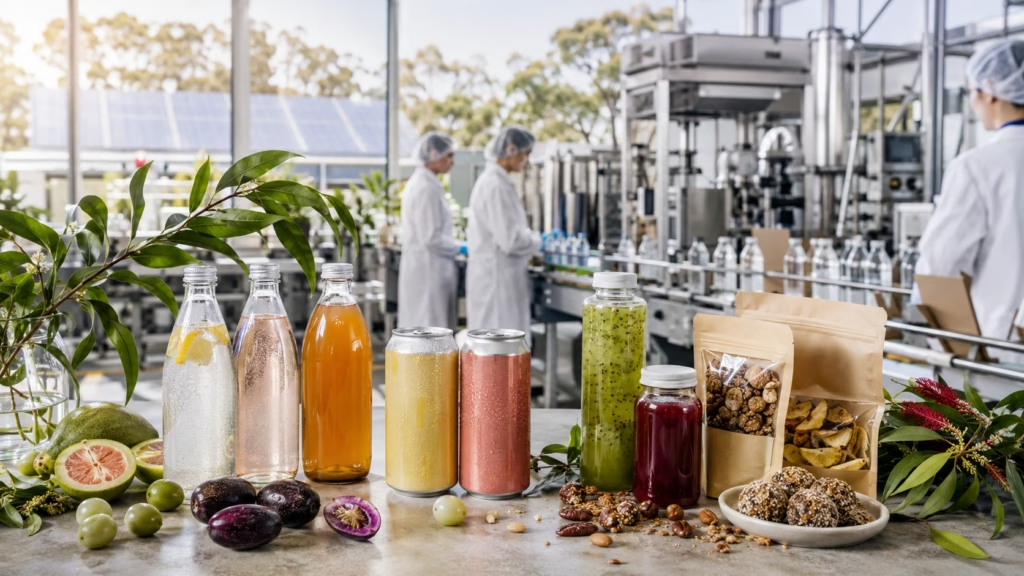
One of the clearest changes in 2026 is the expansion of functional beverages beyond energy drinks. Sparkling waters infused with magnesium and L-theanine, cold-pressed juices with added collagen, and mushroom-based coffee alternatives now occupy prime shelf space. Consumers are looking for hydration that also addresses stress, sleep, and focus. Beverage manufacturers have responded by installing aseptic filling lines that can handle delicate botanicals and live probiotics without preservatives. This technical capability is a key competitive advantage because it allows Australian brands to export shelf-stable functional drinks to Asia without compromising ingredient integrity.
Smart Manufacturing Reshapes the Factory Floor
Automation has moved from large multinationals to mid-sized processors. Collaborative robots now handle repetitive tasks such as sorting, packing, and palletising, reducing workplace injuries and improving consistency. Digital sensors track temperature, humidity, and line speed in real time, while predictive maintenance algorithms prevent costly downtime. According to ABS data, investment in machinery and equipment by food and beverage manufacturers rose by 8% in the 2024–25 financial year. This investment is helping companies manage labour shortages and energy costs while meeting stricter food safety standards.
Local Sourcing Strengthens Supply Chains
Global supply chain disruptions have accelerated a renewed focus on local ingredients. Manufacturers are contracting directly with Australian growers for oats, almonds, macadamias, and native herbs, reducing dependence on imported inputs. This not only shortens supply chains but also supports regional employment and gives products a traceable origin story. Consumers are increasingly reading labels to check where ingredients come from, and brands that can say “grown in Australia” are using that message as a core marketing asset.
Current Case: Ready-to-Drink Cold Brew and Energy Alternatives
A real-world example of this transformation is the rapid growth of ready-to-drink cold coffee and natural energy alternatives. Several Australian brands have shifted from imported coffee concentrates to locally roasted, single-origin beans processed in solar-powered facilities. These products are now being exported to New Zealand, South Korea, and the Middle East. The combination of local sourcing, smart manufacturing, and functional positioning has created a premium category that did not exist at scale five years ago.
What This Means for the Sector
The intersection of functional beverage demand, automation, and local supply chains is giving Australian manufacturers a distinct identity. Companies that continue to invest in flexible production lines and regional ingredient partnerships are likely to lead the next growth cycle.


More Stories
APRA and ASIC Tighten the Screws on Private Credit as Australia’s Non-Bank Lending Sector Hits $200 Billion
Mining and Resources M&A: Australia’s Critical Minerals Attract Record Deal Flow
The Safety Net for Small Business: How ACCI Is Addressing the Mental Health and Financial Pressures of Entrepreneurship