
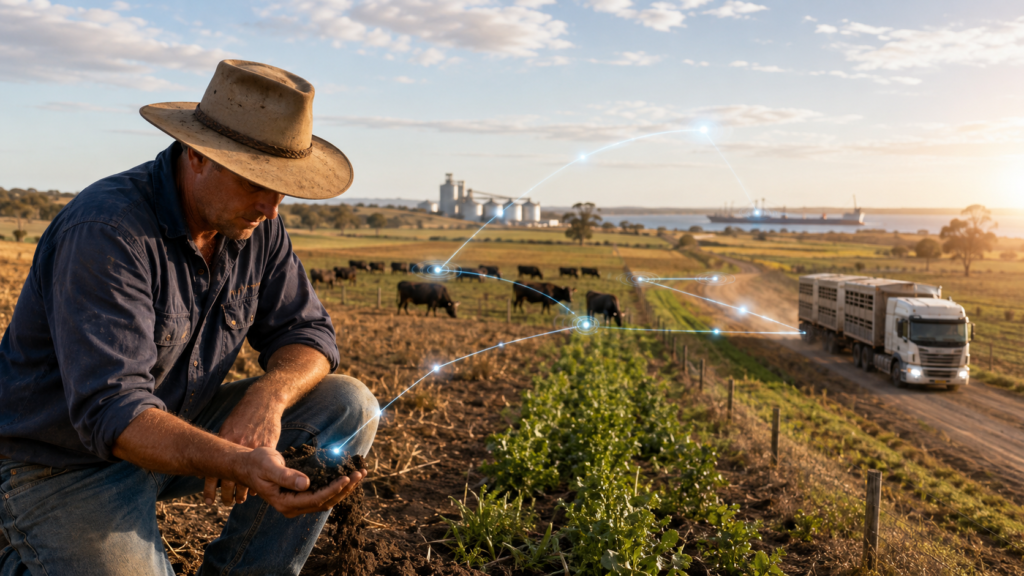
In the red dirt outside Broken Hill, lettuce grows in stacked towers under pink LED lights, fed by desalinated groundwater and powered by solar arrays. This is not science fiction; it is the new frontier of Australian agribusiness.
Why the Outback Is Becoming a Controlled-Environment Agriculture Hub
Australia’s arid interior has abundant sunshine, cheap land and brackish groundwater. Controlled-environment agriculture (CEA) turns those liabilities into assets. Unlike field farming, CEA uses enclosed structures to regulate temperature, humidity, light and nutrients. Companies are building modular vertical farms near remote mining towns and Indigenous communities to supply fresh vegetables that previously arrived wilted after 1,000-kilometre truck journeys.
Hydroponic Systems Cut Water Use by Up to 90 Percent
Hydroponic and aeroponic systems recycle water in closed loops, drastically reducing consumption compared with open-field irrigation. A single vertical farm producing 2 tonnes of leafy greens per week may use only 20,000 litres of water—less than a tenth of what an equivalent field crop would need in a hot climate. This is critical in the Murray-Darling Basin, where water allocations are tight and contested.
Renewable Energy Powers Year-Round Harvests
CEA is energy-intensive, but Australia’s solar resources make off-grid operation feasible. Sundrop Farms near Port Augusta has already demonstrated solar thermal desalination to grow tomatoes using seawater and sunlight alone. In 2026, smaller operators are pairing photovoltaic arrays with lithium batteries to run LED lighting, cooling and water pumps independent of the grid. This allows year-round production even in heatwaves that would stop conventional horticulture.
CSIRO’s Ag2050 Roadmap Targets Regional Food Clusters
The CSIRO Ag2050 roadmap, accessible at CSIRO Ag2050, argues that regional food clusters combining CEA, renewable energy and smart logistics could reduce supply chain emissions by 25 percent while increasing local access to fresh food. The roadmap identifies northern Australia and inland New South Wales as priority zones for investment.
Economic Ripple Effects for Remote Communities
Beyond food security, CEA creates skilled jobs in robotics, plant science and energy management. Indigenous-owned solar farms have partnered with vertical farming operators to co-locate facilities, generating local employment and reducing dependence on imported produce. For remote communities where fresh food prices are often double urban levels, this is a tangible improvement in nutrition and affordability.
Australia’s outback is no longer only a source of minerals and livestock; it is becoming a high-tech food bowl powered by the sun.


More Stories
APRA and ASIC Tighten the Screws on Private Credit as Australia’s Non-Bank Lending Sector Hits $200 Billion
Mining and Resources M&A: Australia’s Critical Minerals Attract Record Deal Flow
The Safety Net for Small Business: How ACCI Is Addressing the Mental Health and Financial Pressures of Entrepreneurship