

Australia’s start-up ecosystem is entering a new phase as 5G technology expands across major cities, regional hubs, industrial zones, and innovation precincts. Unlike earlier mobile networks, 5G is not only about faster internet speeds. Its real value lies in ultra-low latency, higher device capacity, stronger network reliability, and the ability to support real-time digital services. For Australian start-ups, these capabilities create new opportunities to build products that were previously difficult, expensive, or technically limited.
One of the most important impacts of 5G is its ability to support real-time applications. Start-ups developing augmented reality, virtual reality, remote training, digital twins, gaming, and immersive education platforms can benefit from faster response times and smoother data transmission. In sectors such as construction, mining, and engineering, 5G can help start-ups create visual simulation tools that allow teams to inspect sites, test designs, or train workers without being physically present. This is especially relevant in Australia, where large distances between cities, regional towns, and industrial sites often create logistical challenges.
The healthcare sector also presents strong opportunities. Australian health-tech start-ups can use 5G to improve telehealth, remote patient monitoring, mobile diagnostics, and connected medical devices. In rural and remote communities, where access to specialists can be limited, 5G-enabled tools may help doctors monitor patients more effectively through wearable sensors, high-quality video consultations, and real-time data sharing. This opens the door for start-ups to design solutions that address both commercial demand and social impact.
Agriculture is another field where 5G can drive innovation. Agri-tech start-ups in Australia can use connected sensors, drones, autonomous machinery, and AI-powered analytics to help farmers monitor soil conditions, livestock movement, water usage, and crop health. With 5G, large volumes of data can be collected and processed more quickly, allowing farmers to make faster and more accurate decisions. This is particularly valuable in a country where climate variability, drought risk, and resource efficiency are major concerns.
For logistics and transport start-ups, 5G enables more advanced tracking, automation, and fleet management. Companies can build platforms that monitor vehicles, shipping containers, warehouse robots, and delivery routes in real time. This may improve supply-chain visibility and reduce delays across Australia’s vast transport networks. As e-commerce, food delivery, and last-mile logistics continue to grow, start-ups that combine 5G with artificial intelligence and Internet of Things technology may gain a competitive advantage.
However, the benefits of 5G are not automatic. Start-ups must still deal with challenges such as infrastructure gaps, high development costs, cybersecurity risks, and uneven access between metropolitan and regional areas. A start-up building 5G-based services may need partnerships with telecom providers, universities, government innovation programs, or large enterprise clients. Data protection is also critical, because many 5G applications involve sensitive health, location, industrial, or financial information.
Despite these challenges, 5G gives Australian start-ups a stronger foundation for high-value innovation. It allows young companies to move beyond basic mobile apps and build deeper technology solutions in health, agriculture, mining, education, smart cities, logistics, and entertainment. The most successful start-ups will be those that do not treat 5G simply as faster connectivity, but as an infrastructure layer for solving real Australian problems: distance, productivity, sustainability, access to services, and industrial efficiency.
In the coming years, 5G will likely become a key enabler of Australia’s digital economy. Start-ups that understand its practical uses, form strong partnerships, and design scalable solutions will be well positioned to create new markets rather than simply compete in existing ones.
More Stories
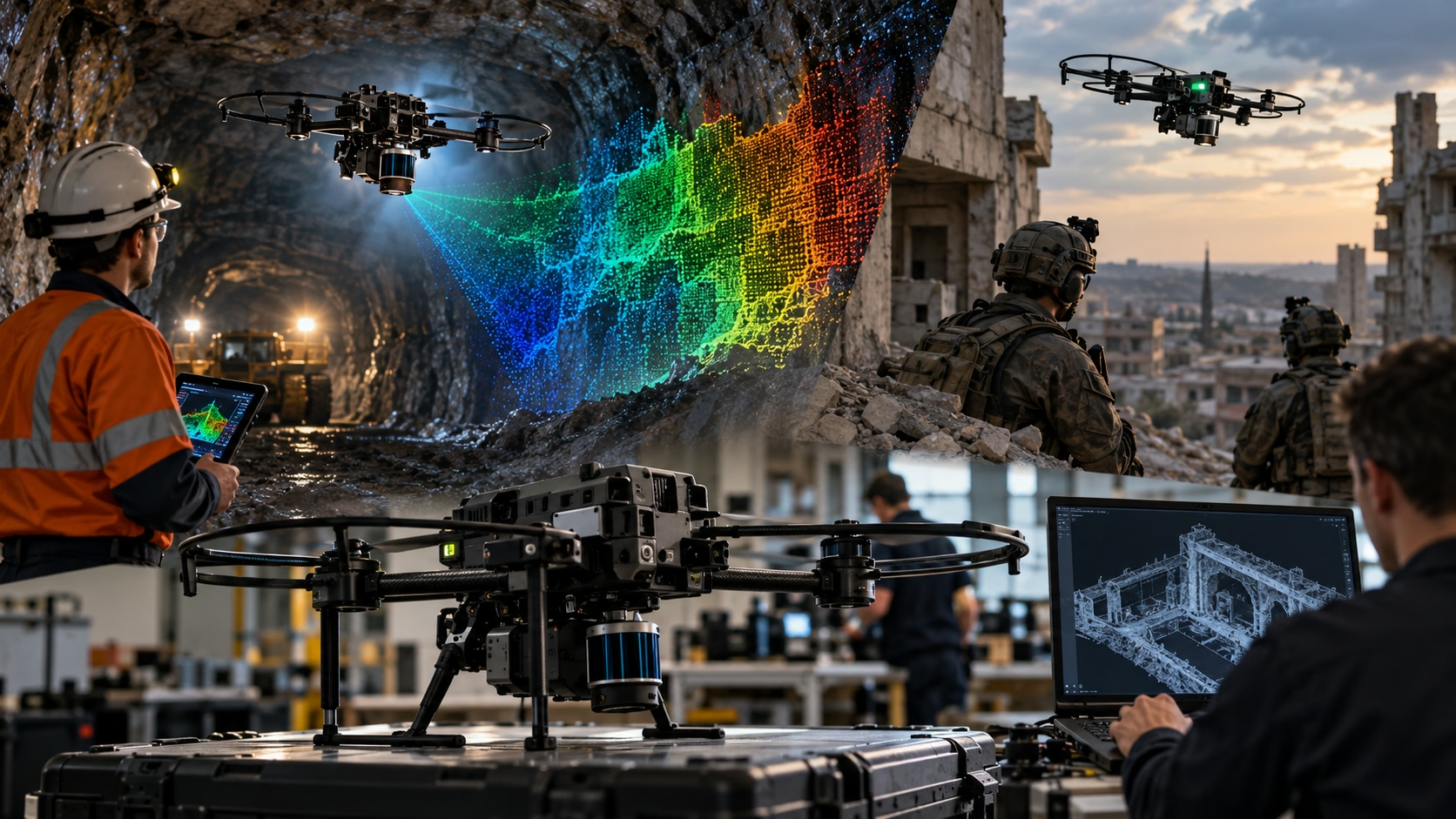
From Mine Sites to Battlefields: How CSIRO Spinout Emesent Is Rewriting GPS-Denied Reconnaissance
Government Policy and the Architecture of Australia’s Deep Tech Future
VR Startups Transform Australian Aged Care and Healthcare Training with Immersive Technology